
Signage studio · Portland, OR
Runs 40 letters a day on one C1; press-fit joints hold without glue because kerf stays under 0.15 mm.
BUYING GUIDE
An optical physics, material compatibility, and cost breakdown to help fablabs, signmakers, and independent artisans invest in the right beam architecture. Scope: this guide covers only the Caverjoy C1 (45W CO2) and Z12 (MOPA fiber) — not other brands.
Start from what you make, not from wattage. Route the decision across six practical dimensions: core substrates, maximum work area, engraving versus cutting tasks, monthly batch volume, the software you already design in, and the floor space plus ventilation you can dedicate.
CO2 = 10,600 nm tube, organic substrates · MOPA = 1,064 nm fiber, metal marking. Both unpacked in section 03.
Both examples are commissioned customer shops. Material, thickness and pass counts are the settings they actually run — not lab best-case numbers.
Runs 40 letters a day on one C1; press-fit joints hold without glue because kerf stays under 0.15 mm.
Tested on the substrates shops actually buy. Read across a row to see what each beam does to the same sheet — where a machine cannot process a substrate, it says so.
Swipe the table sideways for the second machine column.
| Substrate | C1 · 45W CO₂ | Z12 · MOPA fiber |
|---|---|---|
| Hardwood / plywood | Clean single-pass cut, 0.12 mm kerf | Surface ablation only |
| Clear cast acrylic | Flame-polished optical edge | Beam passes through — not supported |
| Stainless / brass / titanium | Not supported | Deep engraving + colour annealing |
| Anodised aluminium | Not supported | Bright white zero-damage marking |
| Leather / fabric | Crisp edges with air assist | Low-char dark etch |
Same ballpark wattage, opposite physics. The C1 is a closed Class 1 cabinet built for organics; the Z12 is an open-format galvo head built for metal. The four fields below settle most of the decision.
Two machines, one decision — pick the one your materials point to. If it does not fit your bench, return it inside the window.
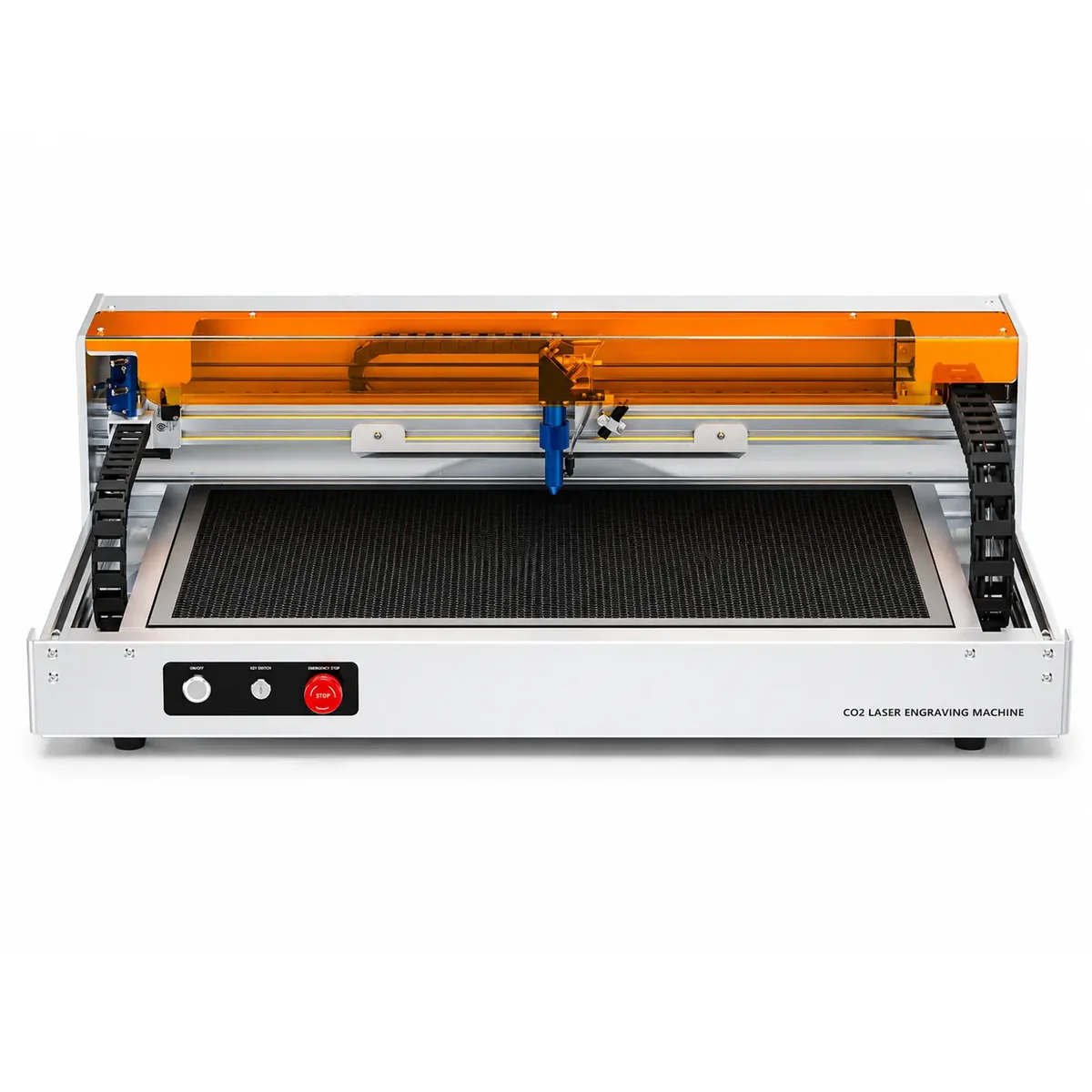
A CO₂ engraver and cutter with a reference 45 W laser, 640 × 350 mm work area, camera positioning, air assist and water cooling.
Current price and stock on the product page
Configure & buy
A desktop galvo fiber engraver for metal marking. Reference options include 20 W, 30 W, 50 W 3D and 60 W MOPA, with model-specific software.
Current price and stock on the product page
Configure & buy| Field (as published) | C1 · 45W CO₂ | Z12 · MOPA fiber |
|---|---|---|
| Light source | CO₂ | Fiber |
| Rated power | 45 W | 20 W · 30 W · 50 W · 60 W |
| Work area | 640 × 350 mm | 175 × 175 mm |
| Class & enclosure | Class 1 enclosed, no eyewear | Open format · OD6+ glasses |
Purchase price is the smallest line over five years. Consumables, site prep and the hours before first saleable output decide the real cost — and the two architectures trade those lines differently.
| Cost line | C1 · 45W CO₂ | Z12 · MOPA fiber |
|---|---|---|
| Machine price | See current product price | See current product price |
| Consumables | CO2 tube and lens kit are wear items | No tube to replace; lens wipe and focus windows |
| Site preparation | Ducted exhaust or HEPA/carbon scrubber | Bench plus local fume extraction, controlled area |
| Time to first sale | 1–2 days of test cuts | 3–5 days to map colour bands |
From crate to saleable output in four stages. Both machines need extraction before the first cut — only the sequence differs.
CO2 needs 6-inch outdoor ventilation or a HEPA/carbon scrubber for organic smoke. Fiber needs compact particulate extraction for metal dust.
Calibrate kerf on 3 mm birch (about 0.12 mm) for press-fit joinery. On MOPA, map 20–400 kHz frequency curves to isolate colour bands.
The Z12 galvo projects a bounding box at high speed — sub-second alignment on pens, knives and coins. On CO2, cut a jig once and reuse it for the whole run.
Signmakers run continuous display-letter production on CO2; knife makers and tactical artisans serialise on MOPA where depth and colour must repeat.
Claims in this guide trace to the references below. Product figures come from the published spec sheets current at the review date.